
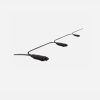
Product Description
The APsystems Rapid Shutdown RSD-S-PLC is a cutting-edge safety solution for modern solar installations. Designed by APsystems, this APsystems Rapid Shutdown device allows fast module-level power shutdown to protect personnel and equipment during maintenance or emergencies. The APsystems Rapid Shutdown meets Canadian CEC 64-218 and U.S. NEC 2017 & 2020 690.12 standards, making it ideal for both new and existing systems with string or central inverters. Utilizing APsystems’ proven module-level power electronics, ASIC with internal IP, and TI chip integration, the APsystems Rapid Shutdown ensures reliable and precise control for every PV module. Compact, robust, and easy to integrate, the APsystems Rapid Shutdown enhances system safety while maintaining optimal solar energy performance.
Other Details
COMPATIBLE WITH
- Use with SMA SunnyBoy-41 and SMA Core1-41 with inverter integrated SunSpec RSD-transmitter
- Use with Fronius Symo Advanced with inverter integrated SunSpec RSD-transmitter
- No external boxes or gateways required, very clean and simple installation
- RSD triggered with loss of AC power to the inverter
SAFE
- Meets Canadian CEC 2018 64-218 requirements
- Meets US NEC 2017 & 2020 (690.12) requirements
- SunSpec Rapid Shutdown certified
- cCSAus certified
RELIABLE
- RSD ASIC Chip designed using APsystems’ IP with redundancy topology
- Highly integrated SoC System on a chip design for lowest component count.
- No DC:DC power conversion for the solar power. Therefore much higher MTBF compared to optimizer based systems.
FLEXIBLE
- Small and light, direct solar module frame mounted with integrated clips
POWERFUL
- Longer daily module operating period (15 ~ 30 minutes) due to its low minimum operation voltage (8V)
- Does not interfere with global MPP tracking algorithms and shade mitigation algorithms e.g. SMA ShadeFix
- Very Low power consumption
STABLE
- Eliminates Unwanted AFCI Nuisance Tripping, approved and tested by SMA and Fronius
- RSD-S-PLC Noise Spectrum Density is far away (isolated) from typical AFCI noise patterns


Reviews
There are no reviews yet.